
Over 70% of mobile app projects miss their original deadline, and that figure doesn't account for the much larger group of apps that launch on time but fail shortly after. According to data from Admiral Media, 99.5% of consumer apps ultimately fail to build a lasting user base. These two numbers, taken together, paint a clear picture that getting the app out the door is hard, and getting users to stay is even harder.
Most people who set out to build an app believe the biggest risk lies in choosing the wrong technology, hiring the wrong developer, or missing a trend in the market. In reality, the decisions that make or break a project are rarely the technical ones. They're the planning decisions, the communication decisions, and the validation decisions that happen before any code gets written, and they get skipped far more often than they should.
What is this blog about?
In this blog we break the problem into the two phases where failure most commonly occurs. The first is during development, where unclear requirements, optimistic planning, and accumulated technical shortcuts cause timelines to stretch well past what was promised.
The second is post-launch, where even well-built apps lose users because of poor onboarding, weak performance, or an underinvestment in user retention.
Thinking about building an app and want to get the planning stage right?
Why Apps Get Delayed
1. Scope Creep
The most common cause of mobile app project delays is scope creep, and most people who've experienced it on a project describe it the same way. Scope creep is what happens when features, requirements, or design changes get added to a project after development has already begun, expanding the scope beyond what was originally agreed upon. It shows up as a new screen requested mid-build or a feature that "shouldn't take long" getting folded in three weeks before launch. On the surface it might look like a decision-making problem but underneath it's almost always a planning problem.
Why does it happen?
The reason scope creep happens so consistently across so many different projects is that most builds begin before the requirements are fully defined. When founders describe what they need in vague terms, such as "a user-friendly dashboard" or "a clean design", the development team has no choice but to interpret those descriptions and start building on assumptions.
For example, a requirement that would have taken two hours to clarify during discovery can consume two weeks of rework once design, architecture, and testing have already been built.
Why does it matter?
Because scope changes don't arrive in isolation, adding a single feature mid-build doesn't just add the time needed to build that feature. It requires revisiting the design, adjusting the architecture, retesting flows, and updating every connected element. According to research from Info-Tech Research Group, 70% of project failures are directly tied to requirements issues, and 50% of all project rework is a direct consequence of those same problems.
How do you prevent it?
The most effective prevention is a proper discovery phase before development begins. Not a brief kickoff call, but a structured process that produces clear requirements and a locked application scope that all stakeholders have agreed to.
Once that scope is locked, new ideas don't get added informally, they go through a formal assessment that evaluates what adding them will cost in timeline and budget before any decision gets made.
2. Unrealistic planning
The second most common cause of project delays is unrealistic planning, and it tends to be the hardest one to argue against at the start of a project. In the early stages of any app, a timeline that assumes everything will go to plan doesn't feel optimistic, it feels like a reasonable reflection of the team's confidence in what they're doing.
Why does it happen?
Because most timelines are built on best-case scenarios rather than real data. People assume that every build will go exactly as planned, every third-party integration will work on the first attempt and no one on the team is going to get sick. If anything, the first few weeks of a project tend to reinforce that confidence when progress becomes visible, the pace feels right, and the deadline still looks achievable. The reality tends to catch up around the midpoint, when a mix of delays that seemed manageable at the time start stacking up in ways that are no longer easy to hide.
Why does it matter?
By the time you realize the original deadline is no longer viable, you are already too far into the build to restart the planning process cleanly. The typical response is to compress whatever phases haven't started yet, but that compression doesn’t make the problems disappear. It just pushes them to after launch, where they cost significantly more to fix and land in front of users before they've been resolved.
How do you prevent it?
Realistic planning means building a buffer into the schedule from the beginning, not as a contingency for when things go wrong, but as an acknowledgment that something unexpected goes wrong on almost every project. Why that’s important is because the difference between a project that lands slightly behind an internal buffer date and one that misses its deadline by a month is the difference between a successful delivery and a failed one.
Wondering how a proper app build is structured from discovery through launch?
Read the blog on our app development process
3. Communication
Communication problems in app development don't typically announce themselves with a single dramatic failure. They accumulate quietly through delayed responses, vague feedback, and decisions that were verbally agreed upon but never written down. A founder who takes three days to review a design mockup isn't just creating a three-day delay, they're stalling every task that depends on that approval.
Why does it happen?
This pattern plays out the same way regardless of how the project is structured. A solo founder working with a freelancer, two co-founders building alongside an in-house developer, or a team coordinating with an external partner all face the same underlying risk: the people involved stop communicating consistently, and the gap between what was intended and what gets built quietly grows from there.
Why does it matter?
It matters because it shows up in the small things that nobody flags as a problem until they've already caused one. A piece of vague feedback like "make it feel more modern" or "the flow seems off" sounds like direction, but it isn't, and whoever is doing the design work has no choice but to interpret it and move forward on a guess. On top of that, conversations spread across email threads, messaging apps, and occasional calls create a version of the project that exists only in people's heads, with no single reliable place to check what was actually agreed when a question comes up three weeks later.
How do you prevent it?
To prevent all of this is simpler than most people might expect. Feedback needs to be specific enough that the person receiving it knows exactly what to change, which means building a habit of asking "what specifically isn't working?" before anyone goes back to make revisions. And every piece of information, including feedback, decisions, open questions, needs to live in one place that everyone on the project can access and search, not scattered across three different tools depending on who sent what and when.
4. Technical Debt
Technical debt is one of those concepts that's far easier to understand in retrospect than to manage in real time.
Why does it happen?
It happens when developers take shortcuts under time pressure, skip tests to hit a deadline, or build quick solutions to complex problems. Each shortcut makes the next feature slightly harder to build, until the team eventually finds itself spending more time maintaining existing code than writing new functionality.
Why does it matter?
What makes technical debt so damaging is that it's almost completely invisible at the start. In the early stages of a build, everything moves fast, progress looks tangible, and the shortcuts feel like smart decisions rather than future liabilities, because there's no evidence yet of what they'll cost later. That evidence tends to arrive after a few months, when new features start breaking old ones with a much higher frequency, so the team begins to realize that the foundation they've been building on isn't as solid as it looked.
How do you prevent it?
Allocating 10 to 15 percent of each development phase to addressing technical debt, rather than treating it as something to handle after launch, is one of the most practical ways to prevent it from becoming a timeline problem. The best time to fix a shortcut is in the same phase of development it was created, because once several more features have been built on top of it, the cost of fixing it multiplies in ways that are difficult to plan for.
Why Apps Fail After Launch
Getting a project through development without major delays is already difficult, and for the teams that manage it, there's a real sense of relief when the app finally goes live. What makes the post-launch phase so challenging is that the problems don't pause to let you celebrate. A new set of risks begins the moment the app is in users' hands, and the first one arrives within seconds.
1. Onboarding
According to data from Admiral Media, 25% of users abandon an app after using it just once. That single statistic points directly to a moment in the user journey that most teams underinvest in: the very first experience.
Why does it happen?
Onboarding is the window in which users decide whether your app is worth their continued attention, and most apps handle it poorly by loading the opening experience with feature explanations, permission requests, and setup steps before they've given the user a single reason to care about any of it.
Why does it matter?
The problem with front-loaded onboarding is really a psychological one. Users who haven't yet experienced any value from the app have no context for why the permissions you're requesting matter to them, so they have no reason to stick around long enough to discover what the app is actually capable of.
How do you prevent it?
You prevent it with effective onboarding that gets users to their first moment of value as quickly as possible. That moment looks different for every category of apps, but the principle is the same regardless. You have to demonstrate the reason to stay before asking the user to invest anything.
2. Validation
Most apps that fail after launch don't fail because of how they were built. They fail because nobody confirmed there was a real reason to build them in the first place. Apps that are built from the inside out, where a founder has an idea and then searches for users who might need it, almost never find the traction they're looking for. The ones that do find a lasting user base are almost always built from the perspective of solving a problem that already exists.
Why does it happen?
Skipping validation rarely comes from laziness. It comes from the founder’s confidence in the idea, and this confidence can make the research phase feel like a formality rather than a test of whether the problem actually exists. Building also feels more productive than talking to people, so teams move into development quickly and tell themselves they'll validate through user feedback once the product is live.
Why does it matter?
A delayed project can be recovered, but a product that nobody needs cannot. That is why building the wrong thing is the most expensive mistake in app development, not because of what it costs to build, but because the cost only becomes visible after launch.
How do you prevent it?
The question worth asking before any development begins is not whether the app can be built, but whether anyone actually needs it to exist. If the people you're building for are currently managing fine without it, that's not a gap in the market waiting to be filled. That is why investing in user research before writing any code, is what separates products that find a reason to exist in people's lives from products that technically function but never get used.
3. Design
One of the more uncomfortable truths in app development is that users have no patience for a product that isn't up to standard. They compare your app to the smoothest experience already on their phone, and they make their decision about whether to keep it based on that comparison.
Why does it happen?
Poor design is almost always a consequence of when it enters the process. Most teams build the functionality first and treat design as something that gets applied on top of it once the core features are working. Under time and budget pressure, that phase gets compressed, and the result is a product that technically does what it's supposed to do but never feels right to use.
Wondering why design plays such an important role in app development?
Why does it matter?
It has been proven that poor design is one of the primary reasons users uninstall apps, and it is one of the few post-launch failure causes that is almost entirely within the team's control before the product ships. The connection between design quality and retention is direct: when an interface is confusing, users don't try harder to understand it, so they leave.
How do you prevent it?
The apps that get this right consistently treat design not as a visual layer applied at the end of development, but as the primary framework through which the entire product is experienced. That means that those decisions are made before development begins, not around it, and the user experience is considered at every stage of the build rather than addressed as a finishing step.
Interested in what our Award-Winning Design of The Year looks like?
4. Retention
Getting a user to download an app is, in many ways, the easy part. According to data from Admiral Media, 71% of users uninstall an app within the first three months of downloading it. This means the vast majority of the users who find your app, install it, and give it a chance are gone before the end of the quarter.
Why does it happen?
Most teams optimize for downloads because downloads are visible, easy to measure, and easy to celebrate. Retention on the other hand, is harder to track and rarely gets the same attention until the numbers become impossible to ignore.
Why does it matter?
Every user who downloads the app and leaves within a month generates no revenue, no word of mouth, and no usable data. At scale, poor retention doesn't just hurt engagement numbers, it makes growth impossible, because the product is losing users at roughly the same rate it's gaining them.
How do you prevent it?
The teams that build apps with lasting user bases are almost never the ones who started thinking about retention after launch. They're the ones who were asking "why would someone open this app for the tenth time?" before they were asking how to get someone to download it for the first time, and that distinction shapes almost every product decision that follows.
According to data from Diversido, nearly 44% of iOS App Store revenue now comes from subscription-based apps, which reflects a broader shift in how successful products think about monetization, not as something you capture at the point of download, but as something you earn by continuing to deliver value over time.
The Stage That Always Absorbs the Pressure
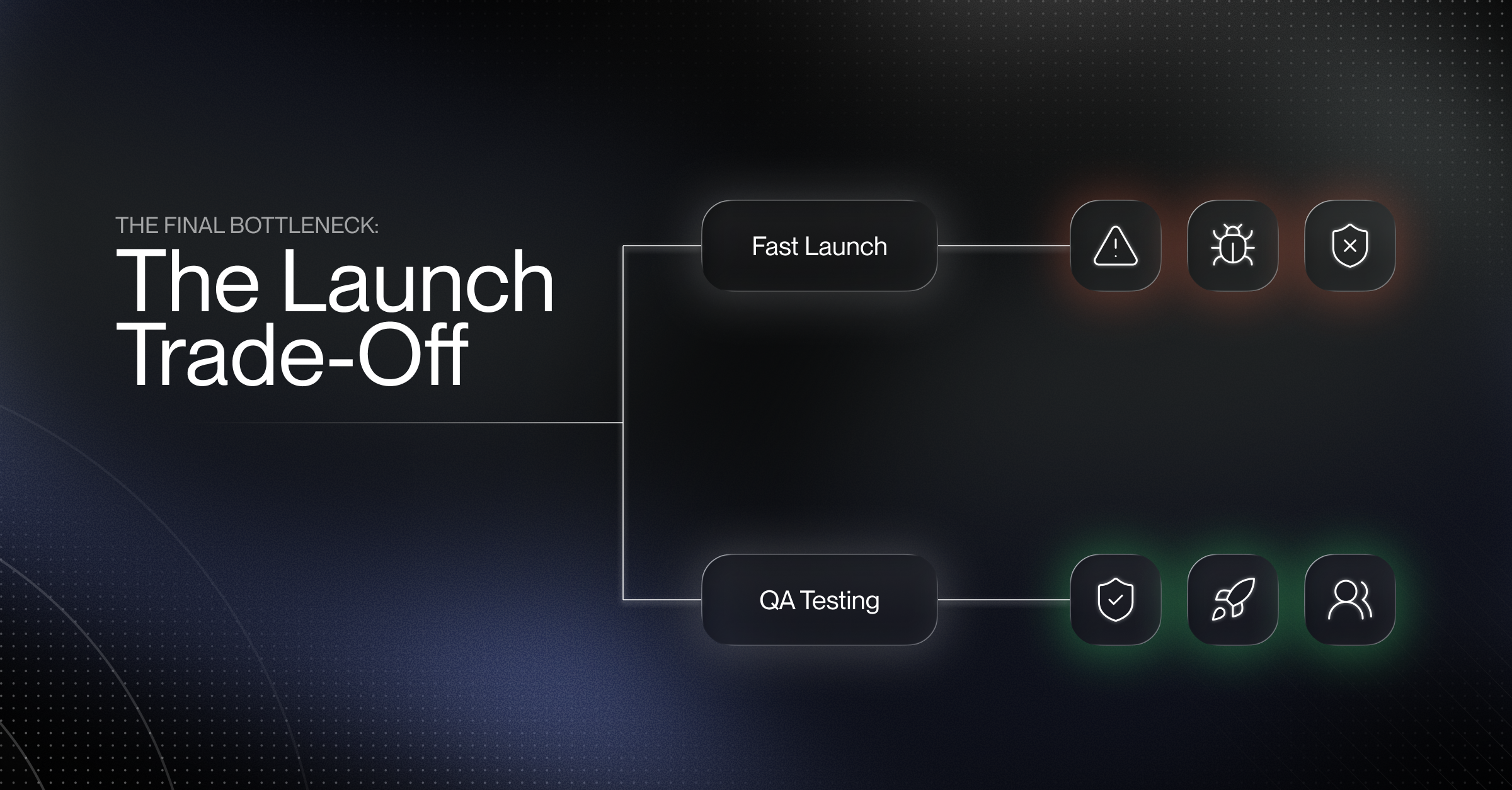
Quality assurance sits at an uncomfortable intersection between the two problems this blog has been describing. Every other cause of delay and every other cause of post-launch failure can be addressed independently. QA is different, because the way you handle it directly determines which problem you end up with.
When you skip it
When a build runs long and the deadline is approaching, the idea to skip testing rarely comes from carelessness and usually comes from making the smartest business move. On one hand, launching faster means getting to users quicker, which means learning sooner, generating revenue sooner, and staying ahead of a competitor who might be moving in the same direction. That logic isn't wrong but it does carry a cost that doesn't show up on the project timeline.
The cost shows up in the user's first week with the product, when the bugs that testing would have caught start surfacing under real-world conditions that nobody on the development team thought to replicate. By the time those problems appear in reviews, the recovery becomes significantly more complicated than the delay would have been.
When you don’t
The other side of that decision carries its own cost as well. A QA phase that is given the time it needs will delay the launch, and that delay has real consequences for momentum, for stakeholder confidence, and for the window of opportunity the product is trying to reach. Neither option is without consequences, and anyone who tells you otherwise hasn't shipped many products.
So what this actually comes down to is an honest conversation about risk, one that should happen before the timeline is set. Teams that decide to skip QA knowingly, with a clear plan for monitoring and rapid response post-launch, are making a calculated decision. Teams that skip it because the schedule left no room for it are not making a decision at all. They're just finding out what the product does when real users get hold of it, and hoping the answer is good enough.
Whether you're working with an agency, a freelancer, or an in-house team, you are welcome to talk to the Calda team about your build!
FAQ
What is the most common reason app projects go over budget?
The single most consistent cause of budget overruns is scope creep, which is almost always a consequence of requirements that weren't fully defined before development began. When the project scope expands mid-build, every addition creates rework across design, development, and testing simultaneously, and the costs compound faster than most people expect.
Can a delay ever be the right decision?
It can, and it's worth distinguishing between accidental delays and strategic ones. An accidental delay happens when problems surface too late to fix without pushing the timeline, which is a failure of planning or process. A strategic delay is a deliberate decision to take more time for deeper QA, security validation, or creating “hype” before going live.
When do most users decide whether to keep or delete an app?
The evidence points strongly to the first session. Data from Admiral Media shows that 25% of users abandon an app after using it just once, and more than 75% are gone within the first three month. The most critical window is those first 60 seconds of the first session, during which users are deciding whether the app delivers enough immediate value to justify continued attention. This is why onboarding deserves as much strategic investment as any other part of the product.
How do I choose between an agency, a freelancer, and an in-house team?
The honest answer is that it depends less on which option you choose and more on how clearly you've defined what you need before making that decision. All three approaches can produce excellent results, and all three can produce the exact same problems described in this blog. The common factor in successful builds across all three models is consistent: clear requirements, structured communication, and a development process that includes proper discovery, testing, and quality assurance. The risks described here apply equally regardless of who's doing the building.
What's the single most important thing I can do to reduce the risk of post-launch failure?
Validate before you build. Before committing budget to development, invest time in understanding whether the problem you're solving is one that real users experience and are actively looking for solutions to. The goal isn't to prove your idea will work, it's to find out whether it might not before the cost of finding out becomes significant.