In a mobile market saturated with millions of platforms, having an app that merely "works" is no longer a competitive advantage. Data shows that 77% of users delete an app within the first three days of installing it and in less than three months, that figure rises above 90%. Not because it crashes or because it has a bug on screen four but because the experience did not feel worth their time.
In this blog, we cover what design-first development actually means, why skipping it costs more than it saves, how the right tooling has closed the gap between design and build, and what to look for in a team that actually lives by this approach.
Thinking about building an app? Before anything else, let’s talk about your idea.
What “Design First” Actually Means
Design first is not about making an app look attractive, it means doing the structural thinking before any development begins.
In practice, that means getting inside the head of the person actually using the product. Where are they coming from, what do they need to accomplish, and where does the logic break down before they get there?
You are essentially walking through the product as a first-time user and attempting to catch the moments where someone might hesitate, lose context, or just give up. That thinking has to happen before anyone applies any sort of visual styling, because a product that looks great but loses people halfway through is still a failure. The goal is to stress-test the idea against real behavior, not just build the thing and hope it works.
The Real Cost of Skipping This Step
Skipping design and going straight to development might feel faster but the numbers tell a different story.
Research from the IBM Systems Sciences Institute, found that the cost of fixing a defect increases exponentially the later it is caught in the development lifecycle. Compared to catching it during design, that cost is 10x higher by integration testing and 30x higher post-launch. The further into the process a problem surfaces, the more expensive it becomes to resolve.
What makes it worse is that teams become reluctant to revisit structural decisions because changing them feels like destroying progress, so they rationalize the problem, add a workaround, or just end up shipping something they know is not right, leading to users feeling the compromise even if they cannot pinpoint why.
Having trouble structuring your app? Book a FREE call with Calda
The Tools That Finally Close the Gap
Historically, there was a massive friction point during the "handoff" between designers and developers. A designer would produce static screens in one environment, while a developer would interpret those screens in another.
That handoff problem has cost teams enormous amounts of time and money for years, and for the first time, we have tools which were specifically built to eliminate it.
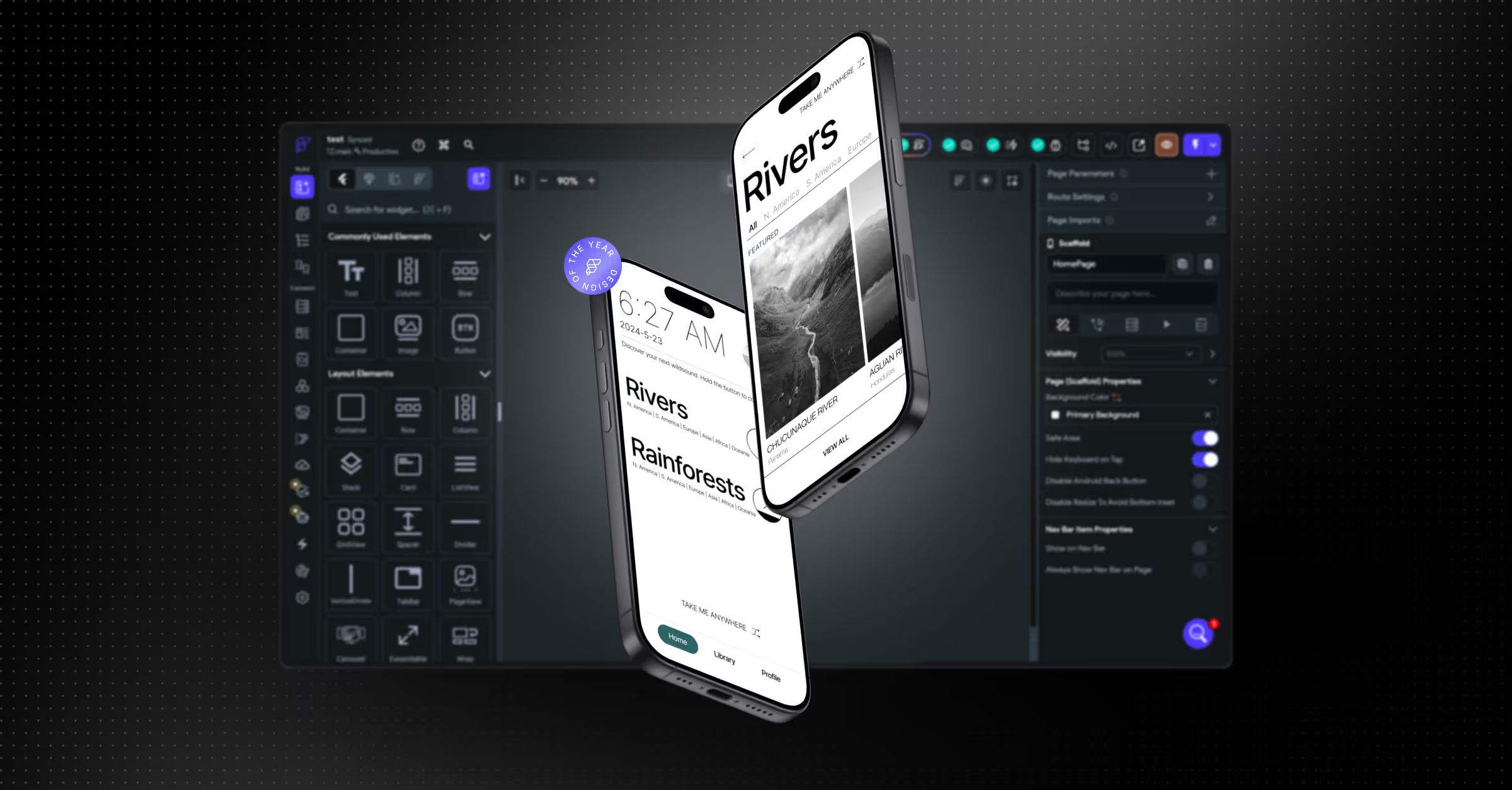
Visual development platforms now make it possible for design and build to happen in the same environment. Rather than producing static images that a developer then has to reconstruct from scratch, teams can build real, functional screens visually. Rather than reviewing static screens and trying to imagine how the finished product will feel, stakeholders can interact with something that actually responds the way the real app will, leading to decisions being made faster and with a lot more confidence.
Which Platform Actually Delivers on This?
FlutterFlow is the platform that comes closest to solving this properly. It is built on Google's Flutter framework, so the output is not a prototype you eventually throw away but production-ready code that goes straight to deployment. Existing design work done in Figma carries directly into the build, which means nothing gets lost or reinterpreted at the handoff stage, and designers and developers can work in the same environment in real time rather than passing files back and forth and losing context along the way.
For design-first development, this matters because it removes the excuse that held teams back for years. The concern used to be that time spent on design was time spent producing assets a developer would just reinterpret in their own way anyway. With a platform like FlutterFlow, that argument no longer holds because the design and the build are the same thing.
Interested in how FlutterFlow fits into our development process?
How the Design-First Process Works in Practice
A proper design-first process starts with discovery, where the team gets a deep understanding of what the product needs to do and who it needs to do it for before anything is designed. From there, the UX designer works out the full logic of the product, figuring out what each type of user needs to accomplish and the most sensible way to get them there. Only once that structure is agreed on does the UI designer come in and apply the visual identity, never the other way around.
When development begins, designers and developers work in the same environment, so there is no handoff meeting where a developer receives a Figma file and has to guess at what was intended. Problems surface early because questions get answered in real time, and the team that starts the project is the same team that finishes it, which means nothing that was figured out during discovery gets lost along the way.
After launch, the same team stays on for maintenance and new features, so there is no handing the product off to someone who has never seen it before every time something needs to change. This is what design-first actually looks like when it is woven into the way a team works rather than treated as a box to tick at the start of a project. And the best way to understand what that produces is to look at a real example.
What an Award-Winning Development Process Actually Looks Like

In 2024, Calda won the FlutterFlow App Design of the Year at the FlutterFlow Developer Conference for the Wildsound app.
The app was not recognised for technical sophistication but for the fact that it felt completely thought through. Navigation was obvious, the product felt like one coherent thing rather than a set of screens loosely stitched together, and every interaction behaved exactly the way a user would expect it to.
That kind of finish only comes from a process where design was never treated as optional.
Interested in what it took to win FlutterFlow App Design of the Year 2024?
How Do You Know If an Agency Truly Designs First?
If you are evaluating agencies to build your app, the process conversation matters more than the portfolio. A good-looking portfolio tells you what an agency has shipped but it does not tell you whether users actually enjoyed those products or how the team got there.
The questions worth asking before signing anything are about the development process, not credentials.
Does the agency show you real design work before development begins, or do they move straight to quoting a build? Do they help you think through the user journey as part of their engagement, or do they wait for you to arrive with a finished specification? Are their designers and developers working in the same environment, or is there a point in the process where things get handed over and detail gets lost? And finally, can they show you working, live apps from past projects, not just screenshots?
The table below shows what the answers to those questions typically look like depending on whether an agency genuinely builds this way or just says they do.
The Bar Keeps Moving
Nowadays users have been trained by apps such as Spotify, Notion, Airbnb, and Duolingo. The standard for what counts as an acceptable mobile experience is not set by your direct competitors, it is set by every well-designed app on a person’s phone.
The gap between a product that functions and one that people actually enjoy using has never been wider, and that gap is almost entirely the result of design decisions that were either made properly before development started or were not made at all.
Design first is not something reserved for companies with large budgets, it is the minimum requirement for building something worth putting in front of users. The cost of skipping it always shows up, either in a rebuild halfway through, in a churn rate nobody can explain, or in an app that eventually stops getting opened.
Saving money by skipping the design phase might seem smart at the beginning, but it will always become your most expensive mistake when you are forced to rebuild it later.
Ready to build something people will actually keep using? Book a FREE call with Calda
FAQ
1. Do I need to have my app fully designed before approaching an agency?
No. A good agency should help you shape the product structure as part of their engagement, not expect you to arrive with a finished specification. What you do need coming in is a clear understanding of the problem your app is solving and who it is solving it for. Everything else is what the design process is there to work out. If an agency quotes a build without asking those questions first, that is a signal worth paying attention to.
2. How involved do I need to be during the build?
More than most founders expect, at least at the start. The discovery and design phases require significant input from you, including your understanding of the user, your knowledge of the market, and your judgment on product decisions. Once development begins and the design is locked, your day-to-day involvement drops considerably. The key is to be highly engaged during the design phase, when your input is cheap to act on, and trust the team during development, when changes are expensive.
3. What happens if users respond to the app and I need major changes after launch?
This is actually one of the strongest arguments for choosing a design-first agency over one that moves straight to build. A product built on a solid foundation can be extended and modified without tearing everything apart, and if the architecture is coherent from the beginning, adding new features or adjusting course based on user feedback is a manageable process. When the foundation was rushed, every change that comes after costs more than it should, and those costs compound the longer the product is live.
4. How do I protect my idea when talking to agencies before signing anything?
Any reputable agency will sign an NDA before detailed discussions if you ask for one. That said, most app ideas are not as unique as founders tend to fear, and an agency working across multiple clients and industries has very little incentive to do anything with your concept. The more practical protection is choosing an agency with a verifiable track record and real references rather than relying on legal documents alone.
5. How do I evaluate agencies when their portfolios all look similar?
Ask to see working apps, not screenshots. A visual portfolio is easy to curate and tells you very little about how an agency actually builds. Ask them to walk you through the process behind one of their featured projects, what discovery looked like, how design decisions were made, and what problems came up during development. How they answer that question will tell you more than anything you will find in the portfolio.