In 2026, a professional FlutterFlow app costs between $10,000 and $100,000+. The overall pricing most commonly depends on the amount of expert hours needed to complete the project, including UX/UI design, database structure and development, API integration, frontend development, airtight security, and overall custom functioning of your app. While you can technically try to develop apps with FlutterFlow on your own with no prior technical expertise, you would require a professional engineering team if you want to launch a truly market-ready app.
So let’s deep dive into what determines the price of a project, the different pricing tiers of project development and the limitations of building an app with FlutterFlow on your own with no prior technical expertise.
What is FlutterFlow?
FlutterFlow is the tool development experts use to develop iOS, Android, and web apps all at the same time.
It is a common misconception to label FlutterFlow as just another "no-code" tool. In the software industry, traditional no-code platforms are often "high-abstraction" platforms, meaning they are easy to build even for those with no technical background, but practically impossible to scale or customize. FlutterFlow is fundamentally different. It is a professional interface that sits directly on top of Flutter, one of the two most commonly used cross-platform development frameworks in the world. .
Unlike tools that hide the code behind vague labels, every element in FlutterFlow corresponds 1:1 with real, professional code. If you inspect the background, you won’t find "spaghetti code", you’ll find clean, industry-standard Flutter structure.
Furthermore, one of the most significant risks for any founder is "Vendor Lock-in". It is the moment you realize your business is highly-dependent on the software you used to build it. If the platform shuts down, raises its prices, or stops updating, your entire business is heavily affected by it.
But here is the thing: with FlutterFlow, you own the source code, it’s your intellectual property.
Because the platform generates standard code, you are never "locked in." If the business ever evolves beyond the platform, the code can be exported and handed to any traditional developer to continue working on it manually.
Curious whether FlutterFlow is the right approach for your product?
Reach out to our team and we’ll help you pick the right stack for your business idea.
What determines the price of building an app with FlutterFlow?
In 2026, the cost of FlutterFlow development is no longer determined by the number of screens in an app.
Instead, the price mostly depends on the app’s complexity, design requirements, integrations, backend setup, and the level of post-launch support.
All of these factors ensure your platform is secure, scalable, and high-performing.
App Complexity and Features
- Every high-level feature adds on to the development hours. Elements such as payment processing, custom scheduling, AI agents, or complex data analytics require specialized engineering to ensure they are secure and "bug-proof”.
App Design
- In 2026, people expect apps to be perfect. If an app feels "cheap" or hard to use, users will leave immediately. This makes design your biggest advantage. A good design will increase the cost of your app, but will ensure smooth movements, easy-to-read layouts, and a look that works perfectly on every device, from phones to computers.
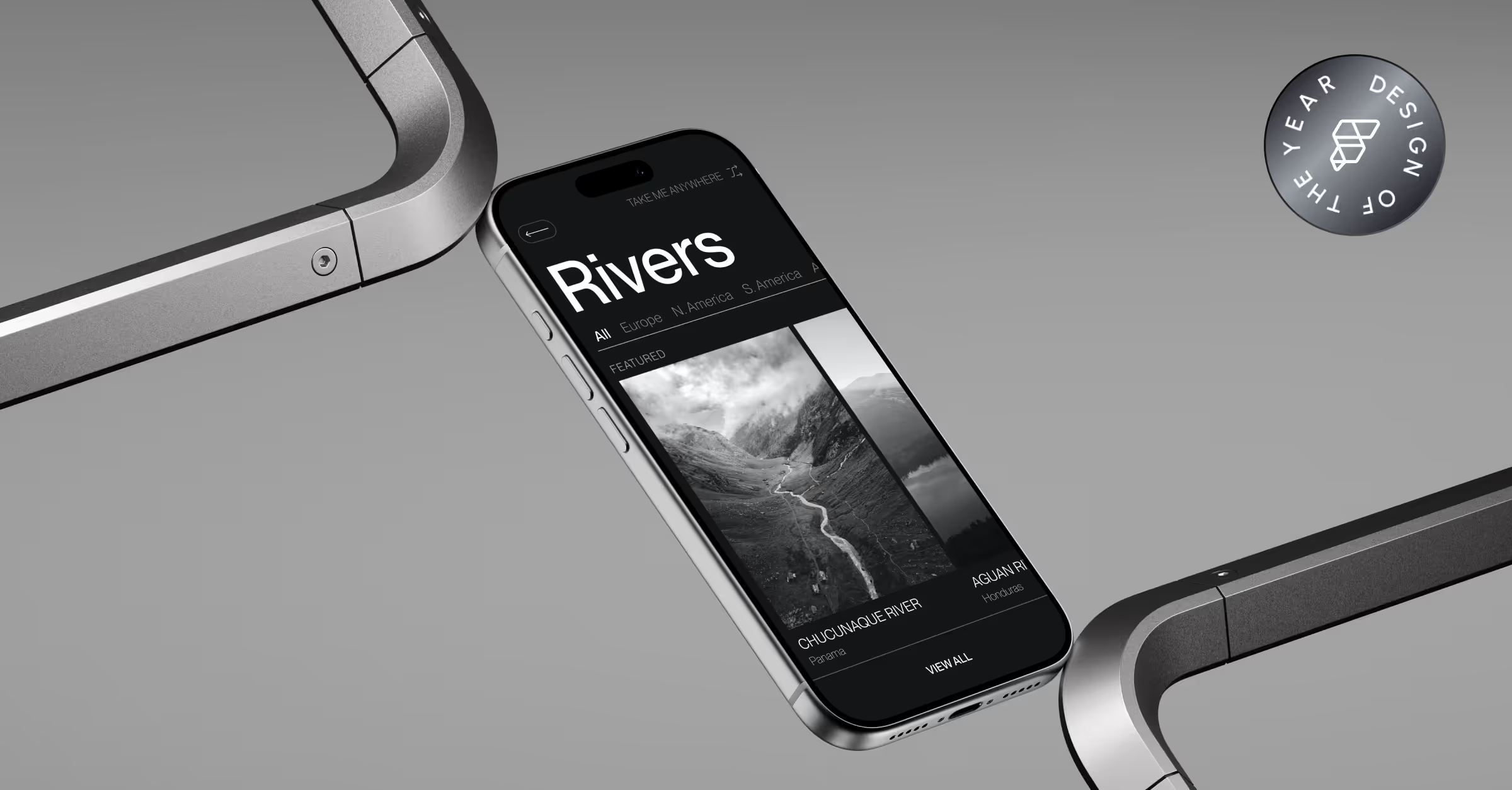
Interested in what our Award Winning FlutterFlow Design Of The Year 2024 looks like?
Backend and integrations
- Backend is the hidden part of an app that handles data storage, business logic, and server operations. The cost changes depending on how complex the backend logic is. This includes choosing a secure backend setup like Firebase or Supabase, and connecting to outside tools like Stripe for payments or Google Maps for location services. Because these connections are complex, they are often where costs increase.
High-level security
- Security is often the most overlooked part in app development. While adding a login screen is simple, building the "invisible walls" that protect user data is a complex engineering task that directly impacts the final price of an app.This includes a critical standard called Row-Level Security (RLS), which is a security policy that ensures only authenticated requests can access certain parts of the database, making your app and user data as secure as it gets.
Launch and Post-Launch Support
- A part of your investment goes into App Store/Play Store deployment, ensuring your product meets the security and privacy rules required by Apple and Google to avoid rejection. Once live, a professional app is a living product, not a one-time project. You must also account for "digital rent" (backend and API fees) and a maintenance budget to handle ongoing updates, bug fixes, and improvements based on user feedback.
Wondering how much it would cost to develop your app?
Book a FREE consultation call with our team today!
What are the 2026 pricing tiers for FlutterFlow app development?
In 2026, there is a clear divide between "hobbyist" builds and professional app development.
To ensure your app is secure, scalable, investor-ready, and market-ready, professional development teams typically start their engagements at a minimum of $10,000.
While you might find cheaper alternatives, those lower prices often come at the expense of data security, custom design, or long-term ownership of your code.
Here is how the 2026 market tiers look:
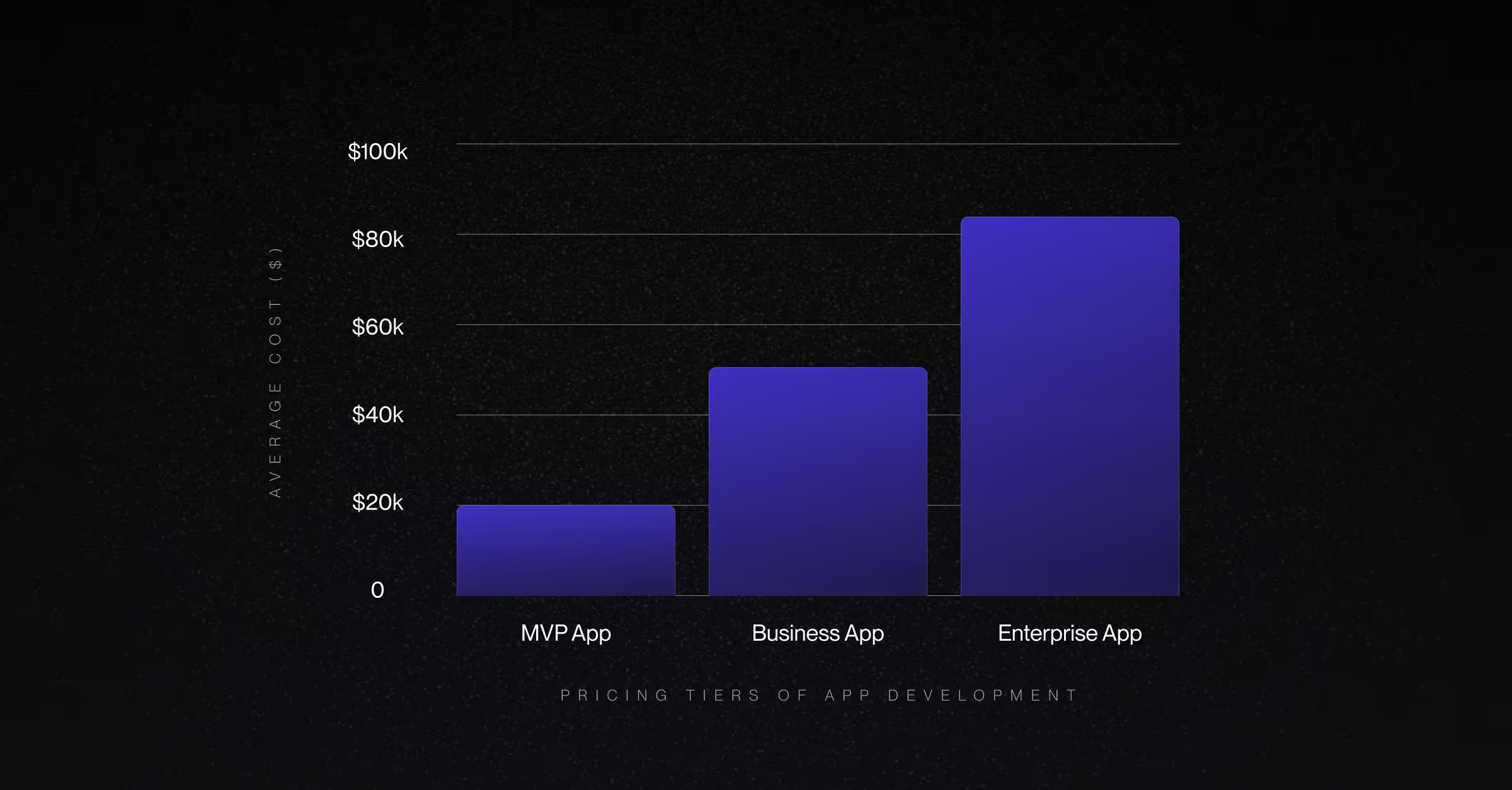
1. The Professional MVP ($10,000 – $30,000)
This tier is designed for founders who are ready to transition from a concept to a market-ready asset. This is not a "prototype" or a temporary test, it is a reliable digital tool engineered to provide a seamless experience for your first 1,000 - 50,000 active users.
- What you get: A high-end, custom-designed interface integrated with a secure database. Development is centered around delivering your core value proposition, with support for advanced functionality, complex user flows, and scalable business logic required for a serious market-ready product.
- Who it’s for: This path is for serious startups that require investor-ready technology or existing businesses wanting to expand their suite of external and internal digital solutions at a market-ready level. It ensures that when presenting to stakeholders or onboarding the first customers, the quality of the app reflects the maturity of the business vision.
2. The Scaling Business App ($30,000 – $70,000)
This tier is engineered for high-growth companies that require a sophisticated digital infrastructure. At this level, the focus shifts from basic features to complex multi-user coordination and the automation of core business processes.
- What you get: A comprehensive ecosystem built around advanced functionality, automation, and scalable operational workflows. It provides a high-performance foundation designed to ensure stability, reliability, and smooth growth as your user base expands rapidly.
- Who it’s for: This path is designed for organizations ready to achieve significant market share.
3. The Enterprise App ($70,000 – $100,000+)
This tier represents a comprehensive digital ecosystem designed for market leaders. These platforms are built to serve as the core engine of a business, capable of supporting thousands of simultaneous users while maintaining peak performance and absolute data integrity.
- What you get: A sophisticated system designed to automate complex processes and support highly advanced functionality. These applications are built with the highest standards of security and thoroughly tested to handle massive data volumes, intensive usage, and high-traffic environments without disruption.
- Who it’s for: This path is reserved for established organizations or high-stakes ventures that require absolute reliability.
Don’t know which tier your app falls into?
Jump on a FREE call with our team to figure it out.
"Can I build an app with FlutterFlow by myself?"
It is a common misconception that because FlutterFlow is considered a low-code platform, it is designed for non-technical users. In reality, it is a professional development platform built to empower experienced developers to work with greater speed and efficiency.
While the interface appears accessible, it still requires a deep understanding of frontend development, business logic, data architecture, and backend integration.
So even though it might look like a cost-effective entry point on paper (for under $50 per month), this path introduces two substantial "hidden" costs that often exceed the initial savings.
- The Cost of Your Time
- A professional app takes about 400 to 600+ hours to build. For most founders, spending five months learning the technicalities of app development is a distraction from their actual goal of building a business. By delegating the development, you aren't just paying for an app, you’re reclaiming months of your schedule to focus on the high-value tasks that actually move the needle.
- The Cost of Mistakes
- There is a significant difference between an app that 'works' and an app that's ready for users. Fixing a "broken" app often costs triple what it costs to build it right the first time. Beyond the technical risks, there is the User Experience (UX) factor. Your first users are your most important, and if their first interaction is frustrating or confusing, you’ve likely lost them forever. Investing in a professional build isn't just about safety, it’s about ensuring that the first time a customer sees your brand, it actually works.
What should YOU do?
If you are building a hobby, doing it yourself is a great way to learn.
But if you are building a business, you have a bigger choice to make: do you want to be the developer or the CEO?
Don’t waste time building something you’ll just have to fix later.
If you’re ready to lead and want a business application that scales from day one, book a meeting with FlutterFlow experts at Calda today.
FAQ:
- Is FlutterFlow cheaper than traditional app development?
Yes, FlutterFlow is usually 30% to 50% more efficient and faster than traditional coding. This is because experts use a visual interface to build the standard parts of the app, while writing custom code for the features that make your business unique and custom to your needs and requirements.
- How long does it take to build an app with FlutterFlow?
FlutterFlow allows us to deliver exceptional apps in the shortest time possible. Most professional builds take 3 to 4 months. A simple version (MVP) can be ready in 8 weeks, while a complex app with loads of custom features might take more than 4 months. This is still significantly faster than the 12+ months usually required for traditional development.
- Do I own the code if I build my app with FlutterFlow?
Yes, you have 100% ownership of your app's code. Unlike "no-code" tools that lock you in, FlutterFlow allows experts to export the raw Flutter code at any time. This means your app is your property, not a rental.
- Can a FlutterFlow app handle a lot of users?
Yes, FlutterFlow apps are built to scale and can easily handle thousands of users at once. Established companies such as Atlas Finance and AB.Money already have live apps built with FlutterFlow and are used by hundreds of thousands of users.
- Is FlutterFlow good for big, complex apps?
Yes, FlutterFlow is powerful enough for complex, enterprise-level apps. Because it allows experts to write custom code and connect to professional databases, you aren't limited by the "no-code" walls. Established companies such as FairPrice Group have used it to build employee apps for internal workflows and engagement.