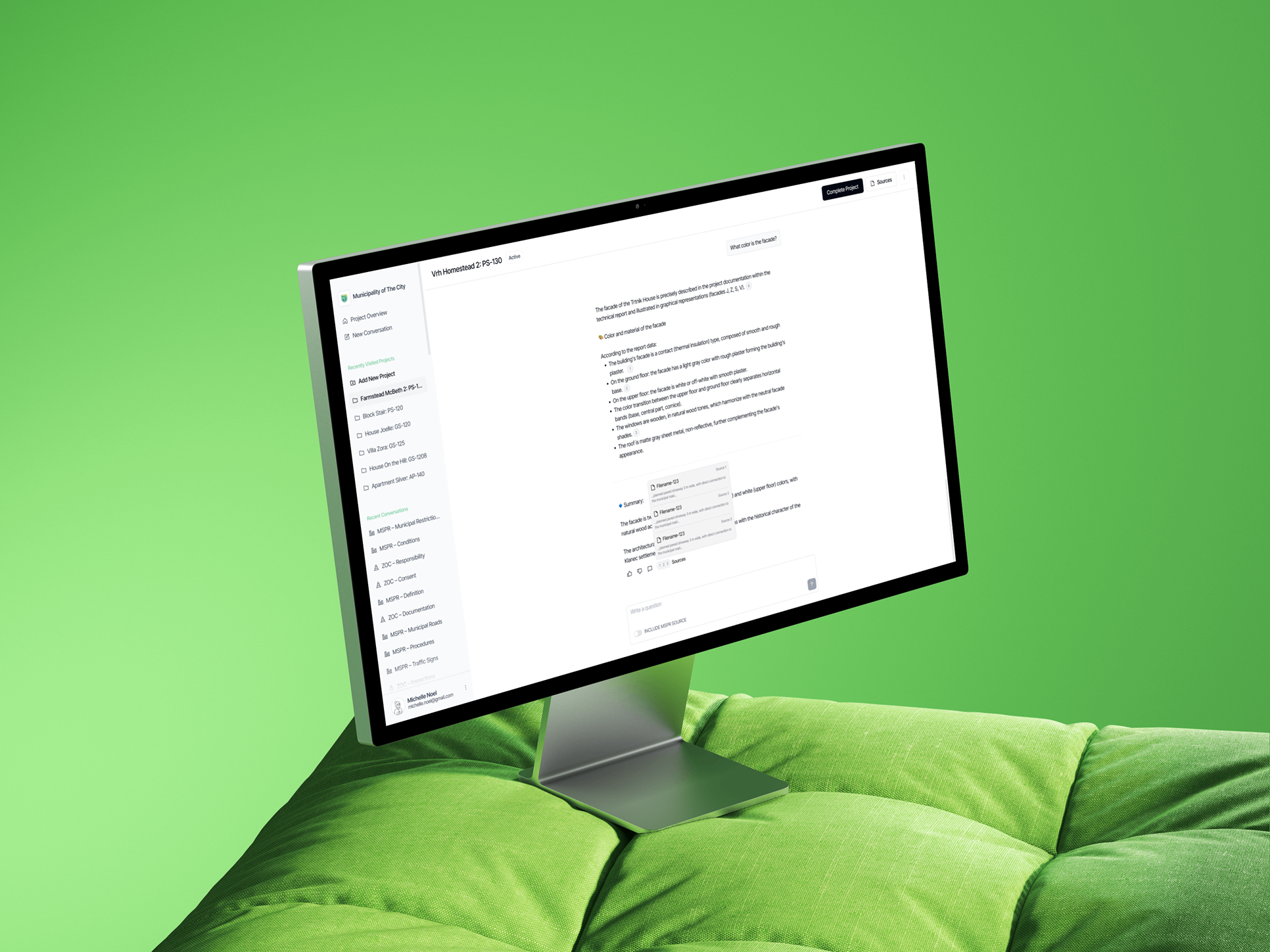
Building permit reviews require public-sector authorities to validate complex submissions against multiple layers of regulation, including spatial plans, building codes, and local requirements. Much of this work still relies on manual, document-by-document cross-referencing, creating a time-intensive process that depends heavily on specialist knowledge.
We encountered this challenge repeatedly with local government authorities, well before Municipality Assistant became a standalone product. Staff was buried in manual cross-referencing, precisely the kind of knowledge-intensive workflow where a properly designed AI system could provide meaningful operational leverage.
A European Union local government authority engaged Calda to address this challenge directly. Calda was engaged to design and build the solution end to end. The engagement began with discovery across existing permitting and spatial-planning workflows, including the systems, regulatory sources, decision processes, and operational constraints involved. Only once these requirements were mapped did product design and engineering begin. Claude was integrated into the architecture from the earliest prototype through to the production system in use today.
We delivered Municipality Assistant as a production-ready solution for building permit compliance, integrating it into the municipality’s existing review process. Following rollout, the system reduced document review time by up to 70% compared with the same task performed manually by the same staff.
Turning Whiteboard Decisions Into Working Screens
Delivering a production-ready system employees could trust required resolving several critical product, workflow, and governance decisions before development began:
- Every generated answer required a traceable source, citing the specific document and page behind it rather than returning unverified text.
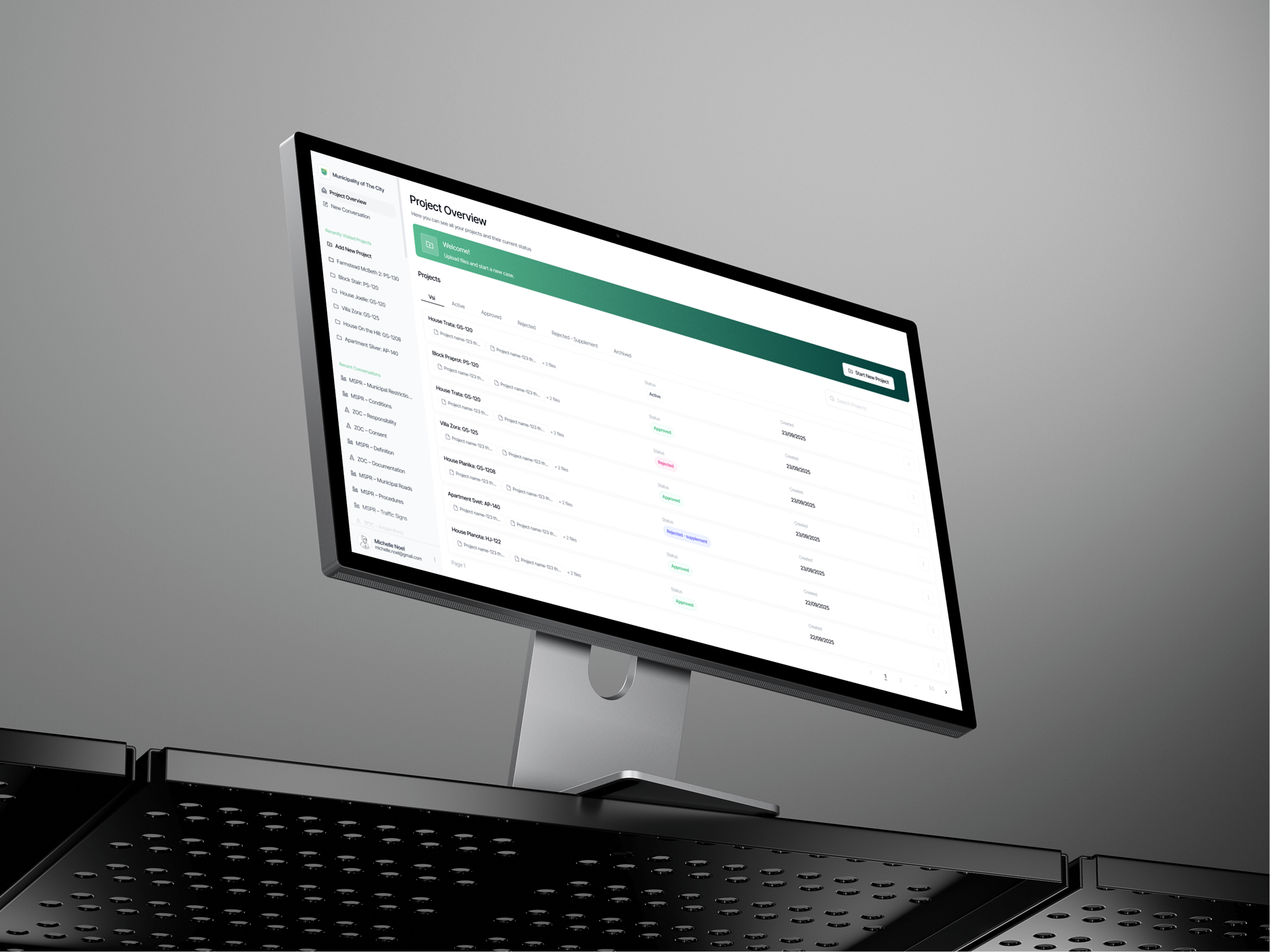
- A plain-language chat interface, allowing an employee to ask directly whether a project documentation complies with specifics of municipality’s spatial plans instead of searching a full report.
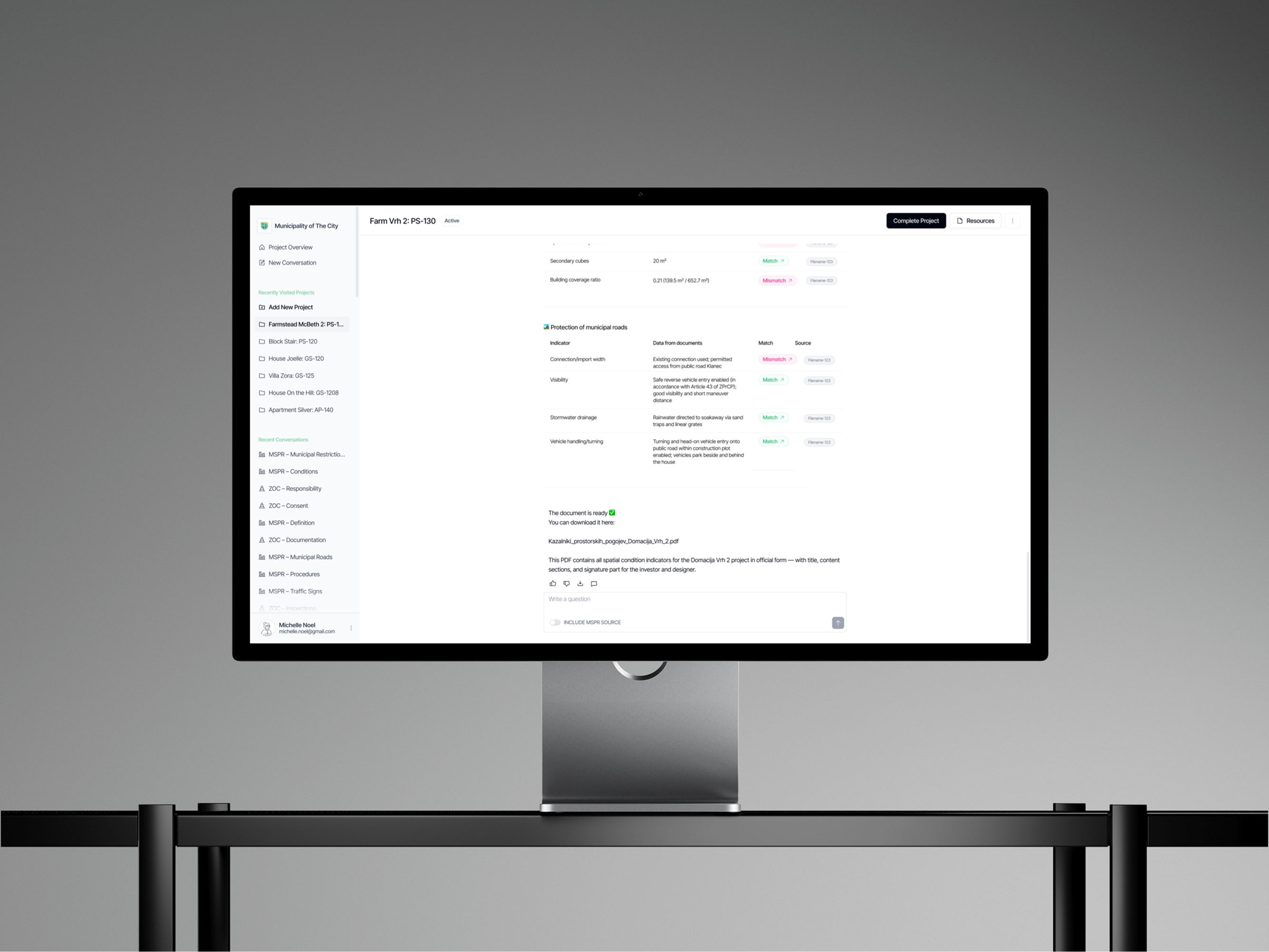
- A structured summary view for complete application reviews, operating alongside a conversational layer for single, specific questions.
- Data that never leaves the municipality's own server, keeping every document and output on infrastructure it directly controls.
We used Claude Design to convert these decisions into functional, clickable interfaces within hours, enabling municipal staff to evaluate an actual product experience rather than assumptions presented on a slide. Decisions that appeared sound in discussion did not always hold up once staff interacted with them directly, and identifying that early prevented our engineering team from building against unvalidated assumptions. This workflow has remained in use well beyond the initial launch, and we apply it whenever a municipality wants to extend the assistant into a new area of its operations.
Where Claude Code Carried the Engineering Load
Once the interface was finalized, our engineering team turned to Claude Code to build a considerably complex product:
- An isolated RAG architecture, indexing each municipality’s spatial plans, regulatory documents, and domain knowledge separately to maintain clear data boundaries and ensure answers were grounded in the correct jurisdiction.
- A document intelligence pipeline capable of ingesting and processing heterogeneous sources, from scanned legacy PDFs to structured digital submissions.
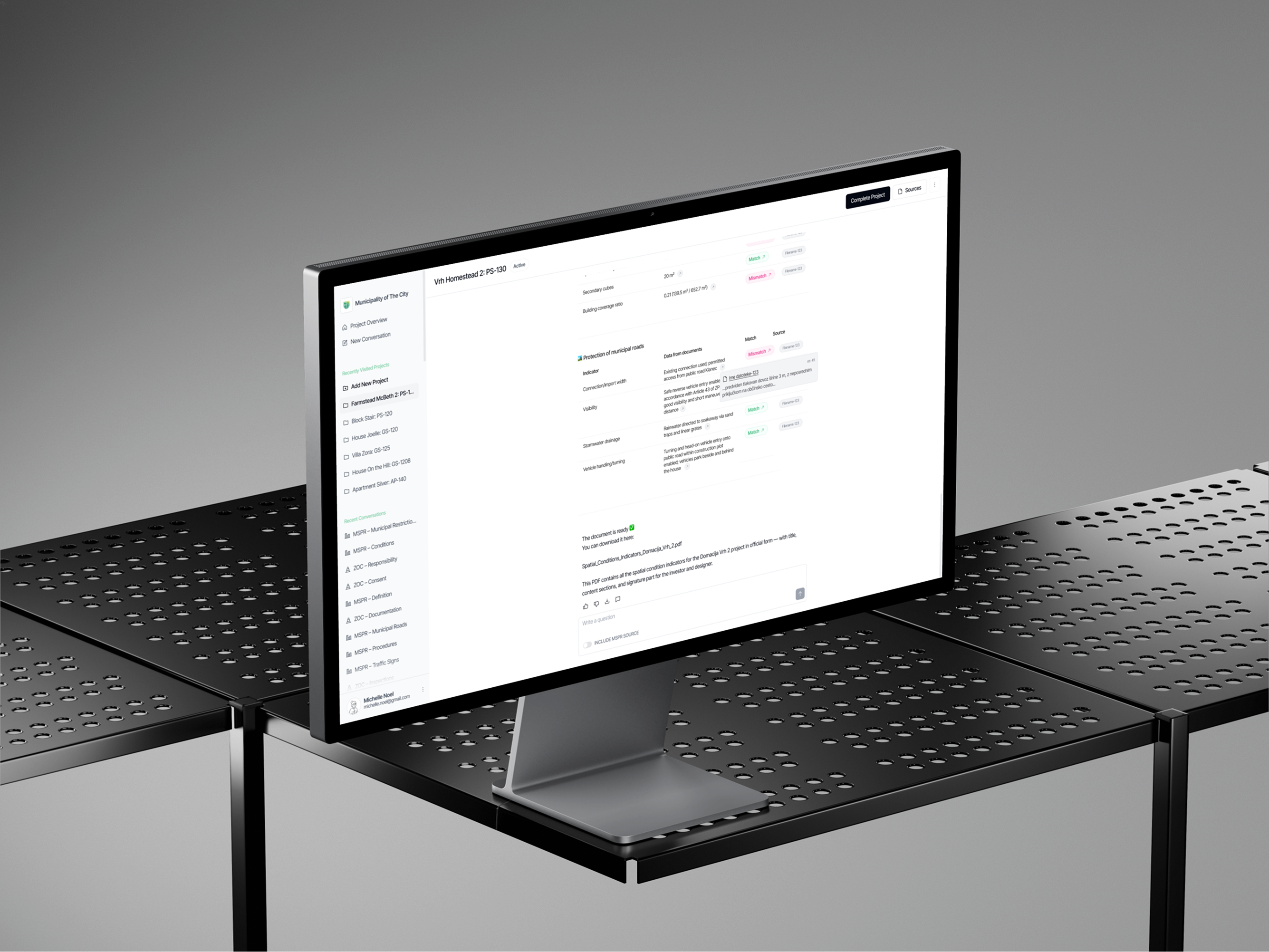
- A source-level citation engine tracing generated answers back to the underlying document and regulatory provision, giving employees a direct path to verify the system’s reasoning.
The product carried little value on its own, given that the system would be relied upon for actual compliance decisions. Prior to going live, our team validated every retrieval and citation pathway against applications staff had already resolved manually, comparing each generated answer against the outcome an employee had reached by hand. Only once results matched consistently across the test set did the system move into production. Today, an employee submits a question and receives a citation verifiable in seconds, without visibility into the validation process behind it.
"It has come to the point where we see a 2-hour process optimization per individual application."
— Primož Cimerman, Mayor, Municipality of Škofljica
How the Claude API Reasons Through Every Application
The Claude API is responsible for reading a submitted application against a municipality's spatial plan and regulatory framework. In practice, that means:
- Flagging specific gaps and mismatches tied to the regulation they violate
- Answering specific compliance questions directly without requiring an employee to open the documents,
- Returning the exact article and page behind every answer so staff can verify it independently.
A human-in-the-loop (HiTL) model was built into the system from the outset. Claude supports employees by retrieving relevant requirements, surfacing findings, and providing traceable evidence, while authority for the final determination remains with municipal staff. This preserves human oversight while substantially reducing the manual cross-referencing required to make informed decisions.
What Municipalities Are Actually Trusting Us With
Municipal records link a citizen's identity to their property and financial standing, and at times to disputes with neighboring parties, information never intended to leave a government office. Which is why every document and output remains on infrastructure the municipality directly controls, nothing is pooled across clients, access is restricted to authorized staff, and encryption governs every layer.
Claude's role is held to the same standard, functioning as a processing layer rather than a repository, with application-level controls determining precisely what context reaches the model. Anthropic does not use commercial customer data to train its models by default, maintaining its confidentiality throughout. Most of this remains invisible to the employee reviewing a report, yet it constitutes the foundation that makes handling information of this sensitivity responsible.
Where This Leaves Municipal Work
The municipality we partnered with was not seeking an AI product. They sought a way to deliver faster permit decisions without expanding headcount, and that objective remained our focus throughout the engagement. Claude proved to be the tool that made solving it achievable on this timeline, present from the earliest Claude Design prototype through the Claude Code build, and it continues to operate today each time an employee submits a question and receives a cited answer in return.
Municipality Assistant has moved a decades-old manual process into a production-ready AI workflow. The system is now live, with discussions underway to deploy it across several additional municipalities in Slovenia.